The man sitting next to me takes out his new Kindle. “How do you like that thing?” I ask. He instantly becomes animated, angling the Kindle toward me so that I can better see its face. “It’s great,” he says. “I can download tons of different books and magazines.” Then, eyeing my hefty, hardback of John Dos Passos’s USA trilogy, he adds, “Cheaper than that, too. $9.99.” There, our conversation ends. I am unsure of where I fall on the Luddite spectrum, but I’ll admit to inhaling the odor of leather-bound volumes. Having moved over a dozen times, though, I’ve also found occasion to curse their weight.
So, too, has Jeff Bezos. Bezos calls the Kindle a response to “the failings of a physical book.” He told attendees of a technology conference in New York: “I’m grumpy when I’m forced to read a physical book because it’s not as convenient. Turning the pages . . . the book is always flopping itself shut at the wrong moment.” His conclusion? “It’s had a great five-hundred-year run . . . but it’s time to change.”
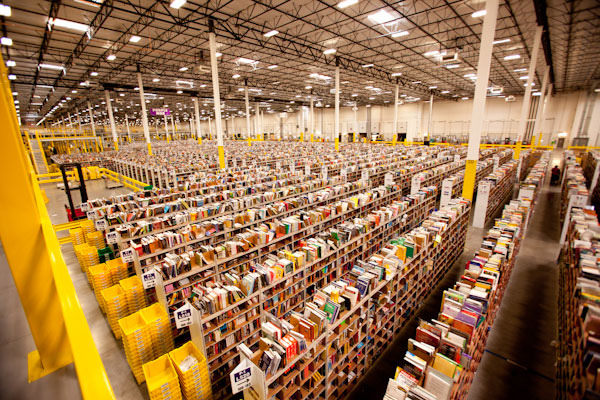
That Bezos is unencumbered by reverence for the physical entity should be no surprise. The book has always been an object of convenience to Bezos, whose principal interest is capturing market share. In 1994 Bezos set out to create a new kind of online business. The specific product was irrelevant; what was important was how it would be marketed, sold, stocked, and shipped. He made a list of the items he could carry, including CDs, videos, computer software and hardware, and books. Books won out because there were so many, and demand was steady. The International Standard Book Number (ISBN) also allowed him to organize and index the millions of books in print. No catalogue or bookstore could possibly have it all, Bezos reasoned, but he could.
Amazon’s ascendance no doubt is a function of its nontraditional ways. Though neither a publisher nor strictly-speaking a bookseller, it has become the world’s largest retailer of books in any form. And it has done so as a software company that offers great deals on Vienna sausages as well as hardbacks. Bezos’s customers come for the low prices, not to fondle, sniff, or otherwise interact with the product. The most one can do is “browse” some pages electronically. Bezos thinks pleasing the customer is all that matters, and his strategy—nearly endless inventory at rock-bottom prices—is working.
Today an estimated 75 percent of online book purchases in the United States are made through Amazon, and its overall market share in book sales is astonishingly high. Some publishers make more than half of their sales through Amazon. So when Bezos rang the death knell for the physical book, people paid attention. Even before the Kindle, Amazon wielded enormous influence in the industry. Now it is positioned to control the e-book market and thereby the future of the publishing industry.
What happens when an industry concerned with the production of culture is beholden to a company with the sole goal of underselling competitors? Amazon is indisputably the king of books, but the issue remains, as Charlie Winton, CEO of the independent publisher Counterpoint Press puts it, “what kind of king they’re going to be.” A vital publishing industry must be able take chances with new authors and with books that don’t have obvious mass-market appeal. When mega-retailers have all the power in the industry, consumers benefit from low prices, but the effect on the future of literature—on what books can be published successfully—is far more in doubt.
For decades the publishing world has been anxious about the end of books. Industry consolidation has led to a much-lamented shift to a business-oriented ethos, particularly at some of the larger conglomerates. With corporate ownership came a demand for profit margins that the book-publishing world had never seen. Yet even if new management is nothing like that of the past—gentlemen with large fortunes who became gentlemen with small fortunes—publishing remains an intensely people-driven business, the kind where folks meet face-to-face. Even today most people involved in publishing are there because they love good books.
For most of their modern history, the primary goal of publishers was to find brilliant writers and produce books. Publishers left it to other book lovers—independent bookstores across the country—to sell the fruits of their labors. Booksellers not only carried books tailored to their local audiences, but also promoted their favorite new books through personal recommendations to their customers. All indies ordered books at a standard discount—somewhere around 40 percent off the list price. In the ’70s and ’80s the number of new book titles grew steadily, as did the number of independently owned bookstores.
But this trend came to a halt when chain superstores such as Barnes & Noble and Borders began taking over in the late ’80s. They set up shop down the street from successful independents, lured customers with a broader array of books and lower prices, and put their competitors out of business. In the early ’90s there were roughly 6,000 independent bookstores across the country. Today, that number is closer to 2,200.
There is not a whole lot of mystery behind these stores’ runaway success. Barnes & Noble wasn’t getting rich by offering caffeine with the classics; it was negotiating better discounts from publishers.
In 1994 the American Booksellers Association (ABA), a group that represents independent bookstores nationwide, filed suit against five major publishing companies for offering discriminatory discounts that weren’t justified by costs. One large publisher, for instance, was requiring that bookstores order 3,000 of their books in order to get a 48 percent discount. A smaller order would net a 40 percent discount. That meant that smaller stores, making smaller orders, could not afford to meet larger retailers’ prices. With even the higher-volume indies unable to compete, small bookstores across the nation were forced to close their doors.
While publishers were guilty of providing two-tiered discounts, there was reason to believe that the chain stores were using strong-arm tactics to demand these discounts of larger publishers. Bruce Spiva, one of the lawyers who brought the ABA’s case, recalls hearing that the chain stores had threatened to remove publishers’ books from stores if they didn’t cooperate.
The five publishers (Houghton Mifflin, Penguin USA, St. Martin’s, Rutledge Hill, and Hugh Lauter Levin) settled, but in 1997 the ABA found that the chain bookstores were still demanding and receiving discounts that weren’t being made available to independent bookstores. The ABA sued Barnes & Noble and Borders directly for leveraging discriminatory discounts. In 2001 this lawsuit, too, was settled, on the condition that a large amount of the evidence the ABA had collected against the chain stores be destroyed.
This era of publishing consolidation and chain growth also marked the rise of “promotional allowances” or “co-operative advertising” (co-op). Big chains pressured bookmakers to pay for top placement in outlets—$20,000 for two weeks in the front of the store, say—or to provide customers special in-store discounts. Such promotions are now standard, with roughly 4 percent of publishers’ net revenue devoted to them.
As the focus shifted to the bottom line throughout the industry, the ABA and many others in the publishing community worried about the effect of revenue-obsession on what would get published, and with good reason. It has become common practice for representatives of large retailers to weigh in on everything from book covers to sample chapters of manuscripts. In some cases, retailers even demand changes. One editor at a major publishing house, who agreed to speak on condition of anonymity for fear of employer sanctions, told me that agents of Barnes & Noble, Borders, and Target are frequent participants in meetings about potential books. Without their buy-in, the publisher is unlikely to go forward with a book. Ideas that excite independents might be scrapped if they don’t get a chain’s stamp of approval.
As a result of this pressure, major publishers have become less inclined to take a chance on new authors and more wary of published authors whose previous works were only moderate sellers. Jamie Raab, publisher of Grand Central Publishing (formerly Warner Books) for 24 years, says that without the independent bookstores to help in the process of “discovery and nurturing,” it became riskier to invest in a talented but unknown writer. Although smaller houses often pick up promising new authors, they don’t always have the resources to pay for preferential status in mega-stores. A full range of new works and authors make it into print, but breakout books for smaller publishers are now rare. And the emergence of Amazon, the biggest of the big-box retailers, has exacerbated these effects while introducing a slew of new headaches for publishers of every size.
In 1995 Bezos’s new online model had the book world atwitter.
Where once a publisher had to worry about competing for limited shelf space, now its entire list of books—old and new alike—could always be available to customers. This was a godsend for small publishers as well as self-publishers, who otherwise had few ways of finding a retail audience. “It’s because of them that our backlist lives,” explains Margo Baldwin, president of Vermont-based Chelsea Green Publishing. “Amazon has been hugely important to us. If you go in as a small publisher and sell to Barnes & Noble or Borders, you have a set of buyers who may or may not take your books. [Amazon has] made the marketplace accessible to everyone in a pretty equal way.”
Publishers were also excited about not having to take so many returns. Bookstores typically order stock from publishers on consignment and return unsold copies, but most of the books Amazon ordered from publishers were non-returnable.
Yet, before long, the mood soured. Over the course of the next decade, Amazon pushed standard discounts to 52–55 percent, with some as high as 60 percent. In contrast, bookstores—even the chains—get discounts that usually top out around 50 percent. That small margin can mean the difference between surviving another day or folding, particularly for a publisher doing modest print runs.
In addition to pushing discounts up explicitly, Amazon began to get creative about what constituted co-op. In 2004 Publishers Weekly reported that publishers were being asked to pay higher co-op rates to Amazon, and those who didn’t sign up would be subject to “such changes as Amazon not selling their books at a discount and not having their titles ‘surface’ in various merchandizing and advertising programs.” There was more: “Amazon also may turn off the search options to publishers’ books, making it possible to find a title only when the correct name of the book or the ISBN is entered.” What publishers were supposed to get in exchange for this co-op, was, essentially, not being made to disappear from the Web site. Winton calls the tactic “a discount grab in the guise of getting co-op”—in other words, a way of getting around antitrust laws that put a cap on the discount a retailer can demand.
Dennis Loy Johnson, head of Melville House Publishing, was one of the publishers approached by Amazon and encouraged to “sign on” to the new program. He refused and two weeks later received a visit from a cadre of Amazon employees at a book convention. “It was one team of guys one day and then another team of guys the next,” he recalled, when we spoke in May of 2009. “They kept saying, ‘Why aren’t you participating in the program?’ in this really heated, aggressive way. I told them we couldn’t afford it.” They countered that Johnson “couldn’t afford not to.”
When Johnson returned from the convention, he discovered that the entire catalogue of Melville House books had disappeared from Amazon.com. “I just didn’t believe they were going to play hardball like that,” he told me. Even a search for ISBNs failed to bring up Melville House’s books. Johnson gave in and agreed to the new plan. Soon after, his books reappeared. In a recent article in The Nation, Johnson says that when he refused to sign onto the new program, Amazon reps told him they were keeping an eye on him and advised him to “get in line.”
Johnson’s story is familiar to Phil Wood, former publisher of Ten Speed Press in Berkeley. Wood received a phone call from Amazon around the same time as Johnson. “What it amounted to,” Wood says, “is that they wanted more discount.” When Wood refused, the “Amazon flunky”—as Wood puts it—threatened to delist all of Ten Speed’s books. “I didn’t even know what that meant,” Wood says. “I told him to go fly a kite.”
Ten Speed’s books then disappeared from the Web site. For about a week, Wood fielded panicked calls from his authors, wondering where their books had gone. Never a fan of computers or email, Wood sat down to pen a letter to Bezos. “I described what his company had done, and I said this was not the way gentlemen treat gentlemen,” Wood told me. He informed Bezos that his next letter would be to The New York Times. After a week Wood received another call from Amazon, further pressuring him to agree to the new terms. When Wood again refused, Amazon relented, and agreed to continue doing business with Ten Speed on the original terms.
High co-op fees allow Amazon to claim higher discounts without asking for them, but sometimes the company doesn’t bother with pretense. Two years ago an Amazon buyer told Kristen Frantz, vice president of sales and marketing at Berrett-Koehler, a San Francisco–based publisher of business titles, that her company’s discounts weren’t high enough. Frantz checked around and found that Berrett-Koehler’s discount to Amazon was about average. She brought her concerns to her distributor, Ingram Publishing Services, and her representative there was able to go to bat on her behalf, arguing to Amazon that Ingram, as Berrett-Koehler’s distributor, should be handling the terms and that the discount should stay as-is. “Once we made that clear to them, they left us alone,” Frantz says. “I think they just try to squeeze everything they can out of publishers, and if you’re small or on your own, you’re going to be much more vulnerable.”
Frantz might be right. Scale seems to matter to Amazon. Ten Speed—responsible for bestsellers such as What Color Is Your Parachute and the Moosewood Cookbook—was doing at least three million dollars in annual business with Amazon. Melville House was doing less than a hundred thousand. But Amazon’s punitive tactics may be more arbitrary than that. A number of publishers have said “no” to Amazon and lived to tell the tale, suggesting that publishers ought to push back harder.
Nonetheless, cases of disappearance continue. Amazon doesn’t always go as far as delisting books entirely. Sometimes it just makes them impossible to purchase by taking the “buy” button off a title’s page. In 2008 two huge British publishers—Bloomsbury and Hachette—had their buttons pulled. That same year, Amazon also removed buy buttons from any printon-demand publisher that didn’t use Amazon’s on demand printer, Book-Surge, a move that led to an antitrust lawsuit in which Amazon agreed to pay a settlement to a competitor, though it admitted no wrongdoing. The Author’s Guild recently launched WhoMovedMyBuyButton.com in order to keep track of buy buttons. On the front page of the site is a note greeting visitors:
See, the folks at Amazon have a headlock on the online book world, and they tend to get carried away. That’s why we developed WhoMovedMy-BuyButton.com. We’ll keep an eye on your Buy Buttons, checking daily to make sure they’re safe. If they’re AWOL, we’ll let you know by e-mail. We’ll also let you know when they return.
Buy-button disappearances are just one of the tensions that have emerged between publishers and Amazon. Publishers accustomed to the more bibliophilic operators of independent stores and even Barnes & Noble find it jarring to deal with Amazon’s lawyers. Wood’s frustration at Amazon’s lack of “gentlemanliness” is echoed by many other publishers who wonder why Amazon keeps putting the screws to them. (The majority of publishers contacted for this article chose not to speak on the record, citing their fear of retribution for divulging Amazon’s tactics, which one publisher described as a “You do this, or we’ll fuck you over” approach.) In a July 2009 interview, Mike Shatzkin, a publishing consultant and author of the popular publishing blog The Shatzkin Files, put it this way: Amazon “sell[s] all kinds of things besides books; they sell their technology. They have a lot of fish to fry besides the fish that the people in the publishing business think about.” And as Amazon has grown in clout, these differing priorities have caused more and more anxiety. “They’re not quite family to the same extent that the retailers have always been in the business,” Shatzkin says.
Publishers who once met directly with Amazon representatives find they can no longer reach anyone at the company, even by phone. Many publishers with distributors don’t even know the name of the person who buys their books at Amazon. The relationship is almost exclusively handled by the distributor. Indeed, of the 20,000 employees at Amazon, just one is tasked full-time with working as a liaison between the company and publishers.
Jeffrey Lependorf, Executive Director of the Council of Literary Magazines and Presses and of Small Press Distribution, suggests that the difference between Amazon and brick-and-mortar bookstores is most evident in how they market books: “I think even people at Amazon would say that it’s essentially a widget seller that happens to have begun by focusing on books. Many people, like me, will say you can’t sell a book the same way you sell a can of soup.”
At the heart of the soup-can analogy are the algorithms that Amazon uses to “recommend” books to customers. Most customers aren’t aware that the personalized book recommendations they receive are a result of paid promotions, not just purchase-derived data. This is frustrating for publishers who want their books to be judged on their merits. “I think their twisted algorithms that point you toward bestsellers instead of books that you might actually like [are] a shame,” Gavin Grant, cofounder of Small Beer Press, laments.
Algorithms can also affect how much customers pay for books. Individual customers may get different discounts on the same book depending on their purchase history. The practice is euphemistically called “dynamic pricing.” According to Roger Williams—the former sales director at Simon & Schuster, and one of the first salespeople to deal directly with Amazon—the complexity of the algorithms is such that, Amazon’s employees “sometimes don’t know themselves what is going to show up in some of the pages that appear.”
In addition to selective pricing and sponsored recommendations, Amazon uses its sales rankings to sell books. One might think that at least these are sacrosanct, generated exclusively from hard numbers. But last year Amazon de-ranked hundreds of gay- and lesbian-themed books. Without a sales rank, the visibility of the titles plummeted. Initially, Amazon claimed this was the result of books being tagged as “adult material,” even though many of the books did not contain content any more explicit than other books that remained ranked. Soon after, the company changed its tack and denied that it had any such adult-material policy. In the end Amazon called it a “glitch” but did not explain what the glitch was, or how it could be prevented in the future.
Amazon’s handling of e-book pricing—and publishers’ response—will have perhaps the most far-reaching effects on the industry. The situation thus far is not encouraging. To create a new market and generate demand for the Kindle, Amazon set the e-book’s price at $9.99. Publishers were not consulted.
If Amazon had asked publishers what they thought about locking in e-book prices at $9.99, it would have been subjected to a chorus of outrage. That’s because the math behind publishing is seldom in a publishers’ favor. The sale of a twenty-dollar hardcover nets a large publisher about ten dollars. Royalties run the publisher about three dollars, and the costs of printing, binding, and paper are a further two dollars (more for low-volume titles). Take $1.20 for distribution, two dollars for marketing, and that leaves a publisher with roughly $1.80 to cover rent, editing, and any other costs. A smaller publisher might keep closer to a dollar per book.
E-books reduce the cost of printing, binding, and paper, but royalties tend to run higher, and all other costs are largely unchanged. Publishers account for these costs when they slap a price tag on a book, so Amazon’s decision to set the price irrespective of them set off a wave of anxiety.
Amazon, hardly oblivious to these economics, chose to absorb the loss, paying publishers for the price of the equivalent printed book in order to make the deal more appealing. But Amazon has successfully established customer expectations at an impossibly low rate, and publishers worry that at some point the retailer will no longer take on losses to sustain it.
“There’s no way they can continue to sell . . . at a loss,” says Johanna Vondeling, vice president of business and development at Berrett-Koehler. “Eventually, they’re going to change their minds on this, and I think all publishers should be worried about what happens when they do. They’re going to keep that e-book price where it is. They’re going to turn around and say to the publishers, ‘Tough. All we’re going to pay you on is the split of $9.99.’”
While the $9.99 price has evolved, it is still the most popular e-book rate on Amazon. And even with elastic pricing, Amazon remains in control, using its algorithms to set the price of e-books.
This past January John Sargent, CEO of the publisher Macmillan, met with Amazon executives in hopes that he might regain control over the pricing of Macmillan’s books. If anyone could sway Amazon, it was Macmillan, a huge bookmaker with imprints such as Farrar, Straus, and Giroux; Henry Holt; Picador; and Times Books. Sargent flew to Seattle and laid out his terms. By the time he stepped off the plane in New York, Amazon had removed the buy button from every Macmillan book on the Web site.
Negotiations between retailers and publishers have historically been behind closed doors, so it was that much more dramatic when an irate Sargent wrote a blog on the Macmillan Web site chronicling the messy details. Before long, Amazon announced that it had no choice but to cede pricing control to Macmillan because the publisher “has a monopoly over their own titles.”
Macmillan’s success is a heartening development. It and a handful of other large publishers have taken over pricing of their own e-books. But smaller houses have not been so lucky. Johnny Temple, founder of the independent press Akashic Books, is not sure whether he will eventually be able to negotiate the same terms that the big publishers have with Amazon. “If we had a room full of lawyers, maybe we would be working with them and thinking about the future terms,” Temple says. “But we’re just busy trying to stay in business.” As is the case with most large retailers, those publishers with a lower sales volume are simply treated differently.
For small publishers Amazon provides unprecedented access to a larger audience of customers. The costs of reaching this audience can, however, outweigh the benefits. For Gavin Grant, keeping Small Beer Press afloat without slashing already-modest author royalties means making cuts in advertising and marketing budgets. Grant isn’t shy about Amazon’s role in keeping him in this tight spot: “If I meet a reader and they say, ‘I buy all your books through Amazon,’ I often say to them, ‘That’s great for Amazon, that’s great for the shipper. It does nothing for me, and it doesn’t do much for the author.’”
Many in the publishing community mock Amazon as the “Wal-Mart of books,” but it’s important to remember that Wal-Mart is also the Wal-Mart of books. Last year, Target, Amazon, and Wal-Mart fought a price war over a handful of new hardcover bestsellers. Books with $25 and $35 retail prices were being offered for nine dollars or less.
In response to the price war, the ABA wrote a letter to the Department of Justice (DOJ), requesting that it investigate possible “illegal predatory pricing.” David Gernert, a literary agent who represents the novelist John Grisham and was quoted in the ABA letter, told The New York Times: “If readers come to believe that the value of a new book is $10, publishing as we know it is over. If you can buy Stephen King’s new novel or John Grisham’s Ford County, for $10, why would you buy a brilliant first novel for $25?” People who tend to read Grisham and King aren’t necessarily reaching for a brilliant first novel, but Gernert’s point still has some force: devaluing the books produced by an industry already squeezed to the brink is not likely to benefit the reader in the end.
The DOJ made no formal reply to the ABA, nor is it likely to (when contacted for this article, a DOJ representative had “no comment” on the letter). Enforcing anti-trust statutes, particularly in the publishing world, has always been a difficult endeavor. The relevant laws (part of the Robinson-Patman Act) have their roots in the 1930s, an era in which healthy competition was measured not only in low prices but also according to the diversity of retailers. A portion of the Robinson-Patman Act states, for instance, that it is illegal to charge different prices in different geographic areas simply to undersell local stores, a practice critical to the business strategies of large companies such as Wal-Mart.
But the DOJ doesn’t bring Robinson-Patman cases anymore, and the Federal Trade Commission (FTC) does so only rarely. John Kirkwood, a former FTC lawyer, explains that the Robinson-Patman Act is thought to be anti-consumer, “so courts are skeptical if not hostile.” The thinking is that, if prices are getting lower, the consumer must be benefiting.
In July Bezos told the press: “Amazon.com customers now purchase more Kindle books than hardcover books—astonishing when you consider that we’ve been selling hardcover books for 15 years, and Kindle books for 33 months.” The company refuses to release exact figures, so there’s nothing to back this claim, but with Amazon cutting the price of the Kindle in order to remain competitive with Apple’s iPad, there can be little doubt that Kindle sales—and e-book sales—are up. Though that part about being astonished probably isn’t true. Amazon’s quest is market control, and it goes to great lengths to ensure it.
“At the end of the day,” an Amazon source explained, “the market is going to determine what the right price for this content is.” The conceit is that that $9.99 price tag is what the market demands. But in this case Amazon is the market, having—with no input from its suppliers—already dictated the price and preempted the standard fluctuations that competition and improved efficiency impose on prices. It was only through Macmillan’s negotiating that a new e-book-pricing model emerged, and then only for certain, privileged publishers.
Cheap books are easy on our wallets, but behind the scenes publishers large and small have been deeply undercut by the rise of large retailers and predatory pricing schemes. Unless publishers push back, Amazon will take the logic of the chains to its conclusion. Then publishers and readers will finally know what happens when you sell a book like it’s a can of soup.
Research support for this article was provided by The Investigative Fund at The Nation Institute.